Jesus Christ
Book of RevelationJesus Christ is the organizing figure of John Shorey’s reading of Revelation: he is presented as the one revealed to John the Apostle, the Lamb authorized to open the sealed book, and the crowned judge who appears at the book’s climactic battle. Shorey’s central interpretive claim is that these depictions belong to a prophetic sequence whose chronology has been obscured by the book’s arrangement; reading them in order, he argues, clarifies Jesus Christ’s role in the events leading to the end of the age.
Identity and Revelation
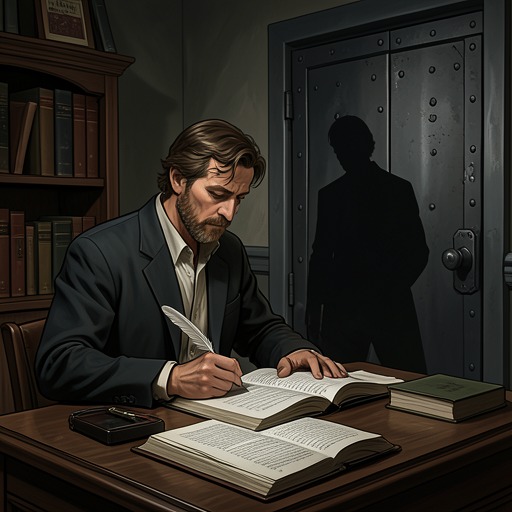
Shorey begins by distinguishing Revelation from an ordinary biblical book. In his account, Jesus Christ appeared to John the Apostle in a vision and gave him the book’s contents. The opening description, however, places the revelation within a chain of transmission: God gives the revelation to Jesus Christ, who makes it known through an angel to John. John’s testimony records what he saw. Jesus Christ is therefore both the subject of the vision and its principal revealer, while the angel and John carry the message onward.
Shorey points to John’s vision on the Lord’s Day as an initial identification of the figure speaking to him. John hears a voice like a trumpet, turns, and sees someone like a son of man among seven golden lampstands. The figure wears a long robe and a golden sash; he directs John to write what he sees and send it to the seven churches. This scene establishes Jesus Christ’s authority to address the churches and gives the book’s prophecies a specific recipient and commission, rather than presenting them as an abstract forecast.
The opening also describes Jesus Christ as a faithful witness, the first begotten of the dead, and the prince of the kings of the earth. Shorey frames these titles as part of the book’s introduction to a figure whose authority reaches beyond the vision itself. His later scenes expand that authority: he is worthy to open the heavenly book, presides over the harvest image, and appears as a warrior-judge at the end of the prophetic sequence.
The Lamb and the Sealed Book
In the throne-room scene, John weeps because no one is found worthy to open the book or even look at it. An elder tells him not to weep and identifies the one who has prevailed: Jesus Christ appears as a Lamb standing among the throne, its attendants, and the elders. The Lamb bears the appearance of having been slain and has seven horns and seven eyes, which the passage associates with the seven Spirits of God sent throughout the earth.
Jesus Christ then takes the book from the right hand of the one seated on the throne. This act answers the scene’s immediate crisis: the book can be opened because he is worthy to receive it. The response around the throne underscores why. The living creatures and elders fall before him, and their song connects his worthiness with having been slain and having redeemed people from every kindred, tongue, people, and nation. In Shorey’s presentation, the Lamb’s authority is thus joined to sacrifice and redemption, not merely to the power that will later be displayed in judgment.
The image also helps Shorey organize Revelation’s sequence. Jesus Christ’s taking of the book belongs to the opening movement of the prophecy, while later images show judgment and its culmination. The book’s changing portrayals do not introduce separate central figures: the Lamb who receives the sealed book is the same Jesus Christ whom Shorey identifies in the harvest and warrior scenes. His arrangement asks readers to follow those roles across the visions rather than treat each image as an isolated episode.
Harvest and Chronological Interpretation
In the harvest vision, a figure like the Son of Man sits on a white cloud with a golden crown on his head and a sharp sickle in his hand. An angel comes from the temple and calls for the harvest because the earth is ripe. The figure thrusts the sickle over the earth, and the earth is reaped. Shorey’s study places this image within his larger effort to distinguish chronological events from material he considers an interruption or explanatory addition.
That distinction matters particularly to his interpretation of the rapture. Shorey argues that Revelation is not entirely arranged in chronological order and that passages placed earlier or later in the book can disrupt readers’ understanding of when events occur. He describes the harvest scene as part of a prophetic account whose position must be assessed alongside the surrounding visions. A reader quoted in the book calls Revelation 14 a picture of the rapture of the Church and says that Shorey’s placement made the timing intelligible to him. That response records a reader’s understanding of Shorey’s interpretation; it does not remove the distinction between the scriptural image and the explanatory framework applied to it.
Shorey’s broader conclusion is that a chronological reading strengthens the case for a mid-tribulation rapture, which he associates with Revelation chapters 7 and 8. He presents this as an interpretation of the book’s sequence, not simply as an isolated claim about the harvest. Jesus Christ’s role in these visions supplies the continuity: the figure who reaps the earth belongs to the same prophetic drama as the Lamb who opens the book and the judge who later appears in glory.
The Returning Judge
At the book’s climactic vision, heaven opens and Jesus Christ appears on a white horse. He is called Faithful and True and judges and makes war in righteousness. His eyes are described as a flame of fire, many crowns are on his head, and he bears a name known only to himself. His garment is dipped in blood, and the name given to him is the Word of God. The heavenly armies follow on white horses, clothed in fine, clean linen.
The scene marks a change in emphasis from the Lamb receiving the book to the sovereign who executes judgment. A sharp sword comes from Jesus Christ’s mouth, and the passage describes him striking the nations, ruling them with an iron rod, and treading the winepress of the fierceness and wrath of Almighty God. His name is written on his garment and thigh: King of Kings and Lord of Lords. Shorey presents this as the defeat of the Beast and its armies and as the decisive appearance of the heavenly warrior. The imagery gives Jesus Christ authority over the nations and places the end of the conflict within divine judgment.
This account also connects to Shorey’s wider discussion of the end-time sequence. He treats the destruction of Mystery Babylon and the subsequent marriage supper of the Lamb as evidence that the rapture has already occurred by that point in the vision. His claim rests on his ordering and interpretation of the passages: the marriage supper, he argues, presupposes that the bride is present in heaven. The returning judge’s appearance therefore belongs not to a free-standing battle episode but to a sequence in which Shorey links the Church’s gathering, the judgment of the Beast, and the establishment of Jesus Christ’s rule.
Narrative Role and Significance
Across Shorey’s account, Jesus Christ’s identities form a progression without cancelling one another. He is the figure revealed to John the Apostle and the authority who commissions the message; as the Lamb, he is worthy to take the book because of his death and redemptive work; as the crowned figure of the harvest, he acts at the earth’s appointed reaping; and as the rider called Faithful and True, he judges and defeats the forces opposed to his rule. Revelation’s titles and images make the book’s prophetic structure personal: its events turn on who has authority to reveal, open, reap, and judge.
Shorey’s interpretive project depends on making those roles legible in sequence. He says that Revelation’s nonchronological passages have encouraged competing interpretations, including disagreement about the rapture’s timing. His proposed arrangement is intended to resolve that confusion and, in his conclusion, validate a mid-tribulation reading. Letters from readers report that the reordered presentation made the book seem more coherent to them, including one reader who describes it as the first time Revelation made sense. These testimonies show how the book presents Jesus Christ’s prophetic role to its audience: not only as the subject of apocalyptic images, but as the figure whose place in the sequence Shorey believes clarifies the message as a whole.